

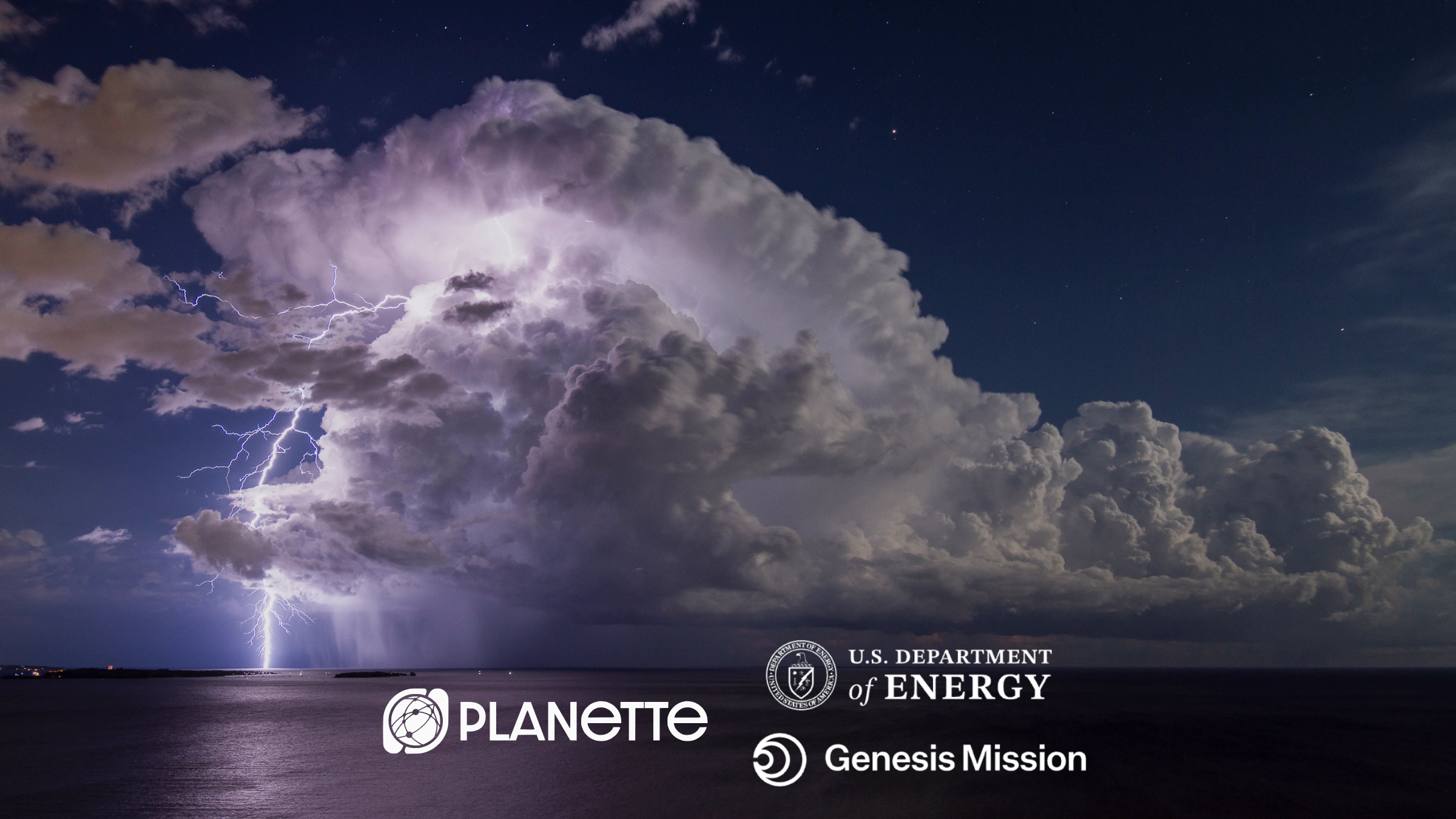
We're excited to share a major milestone for Planette AI.
Planette AI has been selected for the U.S. Department of Energy (DOE)'s Genesis Mission Phase I award, where we'll collaborate with Pacific Northwest National Laboratory (PNNL) and the University of Wyoming on the DL4MCS (Deep Learning for Mesoscale Convective Systems) Genesis Mission Project.
This project brings together leading expertise in artificial intelligence, Earth system science, and physics-based weather forecasting to tackle one of the biggest challenges in meteorology: improving forecasts of dangerous storm systems weeks before they develop.
Why This Matters
Every year, large thunderstorm clusters, known as mesoscale convective systems (MCSs), cause billions of dollars in damage across the United States. These storms can produce intense rainfall, hail, damaging winds, and tornadoes while also providing a significant portion of the country's warm-season rainfall. Although today's weather models perform well over the next several days, forecasting these complex storm systems 7 days to 6 weeks in advance remains one of the most difficult problems in weather prediction. Improving forecasts within this time window has the potential to help utilities prepare for grid disruptions, support emergency managers in planning ahead, strengthen water resource management, and provide better intelligence for weather-sensitive industries.
Introducing DL4MCS
The DL4MCS (Deep Learning Methods to Enhance Subseasonal Predictions of Mesoscale Convective Systems by Physics-based Forecasting Systems) project is designed to explore a new approach to subseasonal forecasting. Rather than relying on AI or physics-based models alone, the project combines the strengths of both.
The research team will investigate how AI can enhance traditional forecasting systems by:
Expanding forecast ensembles to better capture uncertainty.
Using observations from the ocean and land to improve large-scale atmospheric predictions.
Applying deep learning to translate coarse forecasts into high-resolution guidance that better represents storm development and evolution.
Together, these advances aim to improve forecasts of severe thunderstorm clusters at lead times where prediction remains especially challenging.
A Collaborative Effort
DL4MCS is built on collaboration across industry, government, and academia. Each partner brings unique expertise to the project:
Planette AI will lead the development of operational AI forecasting components and hybrid forecasting workflows.
Pacific Northwest National Laboratory (PNNL) will contribute expertise in Earth system modeling, aerosol-cloud interactions, and evaluation of cloud microphysical processes.
The University of Wyoming will provide regional modeling and high-resolution downscaling capabilities to translate large-scale atmospheric forecasts into decision-relevant weather information.
Together, the team will develop and evaluate a proof-of-concept forecasting pipeline using more than a decade of historical U.S. storm observations.
About the Genesis Mission
The DOE Genesis Mission is a national initiative designed to accelerate scientific discovery by integrating artificial intelligence with advanced scientific research. The program brings together government laboratories, universities, industry partners, and philanthropic organizations to explore how AI, high-performance computing, quantum technologies, and advanced scientific instruments can unlock new scientific capabilities. As part of the Genesis Mission Phase I awards, selected teams are developing research workflows that test how AI can improve prediction, accelerate discovery, and generate new scientific insights.
We're honored that Planette AI has been selected to contribute to this effort.
Looking Ahead
At Planette AI, our mission has always been to bridge the forecasting gap between traditional weather forecasts and long-term climate projections. Participating in the Genesis Mission represents an exciting opportunity to advance that mission alongside world-class scientific collaborators. We're thrilled to begin this work with PNNL and the University of Wyoming and look forward to sharing updates as the project progresses.
The future of weather forecasting isn't just about predicting what's coming tomorrow. It's about giving industries and communities the confidence to prepare weeks in advance—and we're proud to help build that future.